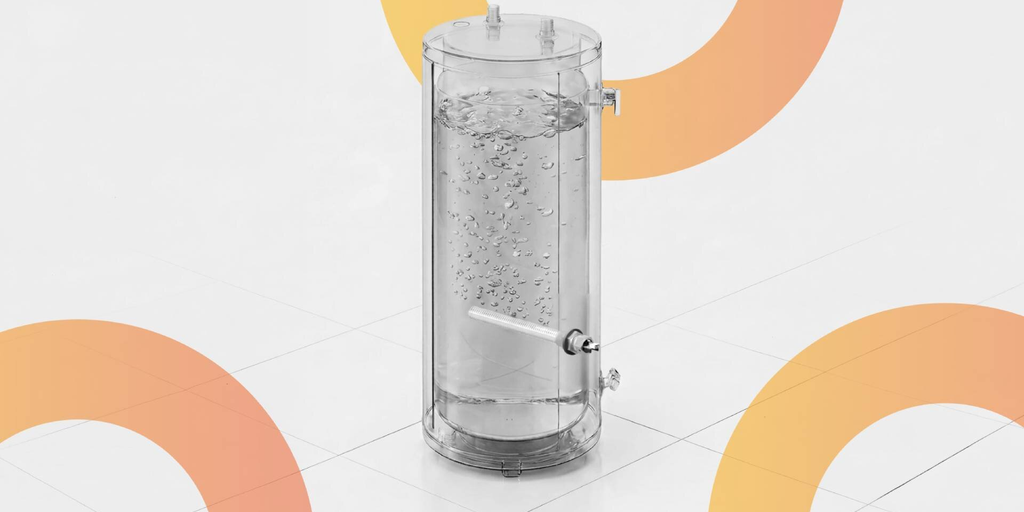
The Bitwater element swaps a tank's resistance wire for 20 mining chips, and Heatbit says it uses the same electricity to heat the water.
In brief Heatbit has unveiled Bitwater, a water heater element with 20 Bitcoin mining chips that screws into existing electric tanks in the U.S. and Canada. The element produces up to 34 TH/s on up to 600 watts, and the first batch costs $899 to preorder, with later batches priced at up to $1,299. Heatbit pitches it as a way to decentralize Bitcoin mining, saying homes use more electricity heating water than the whole Bitcoin network does. Heatbit, which makes space heaters with built-in Bitcoin miners, has unveiled a water heater element that mines Bitcoin while it heats water, the company said in a tweet on Thursday. The element, called Bitwater, replaces the resistance wire in a standard electric water heater element with 20 Bitcoin mining chips, so the heat they give off warms the water instead. “Same heat, same electricity, plus bitcoin,” Heatbit wrote, arguing that “the electricity was going to be spent on hot water anyway. Introducing Bitwater: the water heater element that mines Bitcoin. It screws into the electric tank you already have. Physically decentralized mining that runs no matter what 🧵 Heat water. Mine Bitcoin. Same tank. pic.twitter.com/pRdxPbmpXM — Heatbit (@heatbit_com) October 22, 2026 The element uses 20 of Bitmain’s BM1370 chips and is rated at up to 34 terahashes per second, drawing up to 600 watts at an efficiency of 12 joules per terahash. The water cools the chips, so there are no fans and no noise, according to the company. Heatbit describes installation as a do-it-yourself job: switch off the breaker, drain the tank, unscrew the old element and thread in Bitwater using an included wrench. It fits the standard one-inch port on regular 30- to 80-gallon electric tanks in the U.S. and Canada, including those made by A. O. Smith, Rheem, Bradford White, Whirlpool and GE, Heatbit said in a follow-up tweet, with no plumbing changes or new circuit needed. At up to 600 watts, Bitwater draws far less power than the 4,500-watt elements common in U.S. tanks. Those heat water fast and then shut off, while Bitwater heats more slowly and runs for longer, Heatbit explained . When demand spikes, the tank’s existing upper element still provides backup. Bitcoin BTC · USD $81,610 − 1.25 % 24H 7D 1M 1Y YTD Oct 16 Oct 18 Oct 20 Oct 21 Oct 23 $84.8k $83.5k $82.2k $80.9k 24h High High $81,965 24h Low Low $80,989 Vol Vol $1.1B Market projections Odds by Myriad Today $80,000 to $82,000 $80k–$82k 64 % chance This week Below $82,000 Below $82k 59 % chance → Buy Bitcoin with USDT Powered by Jupiter $ 50 $ 100 $ 500 Buy Price data by CoinGecko CoinGecko More Bitcoin news and projections → Users can track water temperature, hashrate and earnings in an app and choose between solo mining and joining a pool, with mined Bitcoin going to an address they control. Preorders for the first production run, which Heatbit calls its “Genesis batch,” cost $899 , with later batches priced at up to $1,299. The refundable preorders are due to ship in the first quarter of 2027. Heatbit said it tested the element through the winter with households of four and five in New York and Florida, and teased a product for homes with gas water heaters. Heatbit’s home mining pitch Heatbit is pitching Bitwater as a way to spread Bitcoin mining across homes. Homes worldwide use about 300 terawatt-hours of electricity a year heating water, compared with about 170 terawatt-hours for the entire Bitcoin network, the company said. “Public miners are fleeing to AI and dumping coins to pay Wall Street and CEO salaries,” Heatbit wrote. “Home miners answer to no one.” Large public miners have been moving into AI. Bitcoin miners struck 17 deals worth more than $110 billion over two years, contracting out roughly 6 gigawatts of power to companies including Google, Amazon, Microsoft, Nvidia and CoreWeave, Bernstein said earlier this year. The bank expects AI revenue at the miners it covers to grow from $1.2 billion in 2026 to $10.7 billion by 2030, and has said the sector’s planned power capacity of more than 27 gigawatts makes miners key suppliers for the AI boom. Myriad: How high will Bitcoin go? Click to make your prediction. The two businesses work differently, though. Bitcoin miners can switch off to relieve pressure on the grid, while AI data centers need power around the clock. “We’re interruptible [as Bitcoin miners], whereas a traditional data center needs (to be) on 100% of the time,” Shanon Squires of Compass Mining told Decrypt in March 2025. The company’s first product, a space heater with a built-in miner, cost almost $700 in 2023. Founder Alex Busarov told Decrypt at the time that it would always earn something however mining economics changed, because the heat it produced was replacing a conventional heater’s. “Dyson doesn’t make you any money. This one does.” Daily Debrief Newsletter Start every day with the top news stories right now, plus original features, a podcast, videos and more. Email address Join free Join 72,000+ readers Create an account to save your articles. Add on Google Add Decrypt as your preferred source to see more of our stories on Google.